
How I Lost My Rhythm

There was a time when I wrote like breathing.

Not every day, but often enough to feel like I had a rhythm. A cadence. A pulse.

And then one day — I didn’t.

No dramatic event. It felt like a series of tragedies and a car in a slow-motion skidding off a winding road and into the abyss of a canyon… or maybe since I am in Kenya… picture driving the Mai Mahiu Road just after the View Point and winding off the banking and into the Rift.  

The way my ability to write left me… No grand announcement. Just a quiet grinding to a stop. Like faulty gears whose teeth are stuck.

Suddenly, writing felt like trying to catch a moving train while half-asleep. My ideas came foggy and late. The characters in my head stopped speaking. Sentences no longer danced — they stumbled. Or sometimes sat mute between full stops and elipses.

For a while, I told myself that I was just tired. I’d get back into it “soon.” You know, after I finished that thing, solved that crisis, bought that lamp, reorganized that drawer. Maybe if I got an Apple Pencil so that I could scribble like in a notepad but the words could be transcribed to text. Or maybe I could dictate my thoughts and then transcribe the records. OR I could actually commit to NaNoWriMo.

But “soon” left me by myself in the deep Rift of nothingness.

And then the guilt started stacking.

I’d open my laptop, scroll through old drafts, wince. Start a sentence. Delete it. Close the tab. Repeat. 

I even got an expensive Writing Coach… who I ghosted! At least we got to Chapter 3. I still haven’t opened the emails with the notes on Chapter 1 and 2.

People kept asking about my next book. Friends I hadn’t seen in a while asked, “Are you still writing?”

The answer was always a tentative “Yes!” 

To which my conscience would scream “LIAR!!!”

Other times, I would narrate my plot story line.

Other still would be met with a near honest, “Sort of.”

What I meant was, “I don’t know how to explain that I’ve lost the rhythm of myself.”

That the comfort of writing was no longer soothing. And the sadness inside me was all wastelands. No words.

So. Here’s what I’ve come to understand:

I didn’t stop writing because I became lazy. I stopped because I was surviving. Because I was tired in the kind of way sleep couldn’t fix. And the feelings I had were like mud or black, tarry, gooey melted asphalt. 

I have come to understand that somewhere in all the striving, I stopped listening to myself.

And rhythm — real rhythm — requires listening.

It requires stillness. It requires a lot of honesty. 

Presence. And reckoning. The ability to say “Whoosh! I am in a difficult space.” And then to quiet and just allow the soul the attention. I mean the kind of soft attention that’s hard to access when you’re just trying to make it to next week without collapsing. Or wake up without the heaviness of being alive.

Fast forward to this year, something’s shifted. I feel lighter. I feel buoyed (you know like that bobbing orange ball that they keep near boats and things). I’ve started humming again while brushing my teeth. I’ve caught myself narrating random scenes in my head. Started seeing the imaginary spaces where stories form come alive with color again. I’ve started writing things in the margins of my journal and even randomly between meetings on open Word documents… hehehe…

The rhythm is not back in full. But I can hear it again. Faint. Familiar. Like music playing softly in another room.

I feel compelled to follow the sound. Slowly. Steadily. No rush.

Because the thing about rhythm is: it always leaves room for return.
Notes to my Younger Self

Dear girl,

Oh dear, little girl. I wish we had had this conversation earlier.

You don’t have to prove your worth by how much you can endure.

You don’t have to fix everything before you allow yourself to rest.

You don’t need to explain why your joy matters. Or why your tears are valid.

Someone, some time, convinced you that love is earned through effort. That you have to be useful to be kept. That you have to keep working harder and faster than anyone to stay ahead of crises unknown. That you have to anticipate needs before anyone speaks them. And honestly? You’ve gotten really good at that.

But I want you to know — you were never supposed to disappear in order to belong.

You think you’re being “easy” when you wait just a little too long to ask for help.

You think you’re being mature when you withdraw tactfully when you’re pain to yourself.

You think you’re being strong when you say “it’s fine” even when it’s not.

But baby girl — I see you.

And I know you’re tired.

Let me tell you a few things I wish you had heard sooner:

You are not dramatic. You are expressive.

You are not weak. You are emotionally attuned.

You are not too much. You are in full color. You just have a not-so-quiet stubbornness to be just you. You are not unstable. You are just full of life and committed to living truthfully (at least by not lying to yourself, no matter what).

Oh, sweet girl. Life has taught us that there always will be people who won’t understand you. Some even in the circle of those who love you the most. That’s okay. Don’t twist yourself trying to understand why this is the way it is. Don’t even try to analyze why they don’t get it. You’ll learn, eventually, and be okay with not always being the Belle of the Ball. And the world will not end.

And here’s something else: one day, you’ll learn the joy of finding your tribe. And people who make you feel compelled to keep your softness. Keep your curiosity. People who amplify your voice, even when it trembles, and who hold your hand through everything. It is a wonderful joy to be loved by other people than those who first loved you and have been so steadfast (that huge family and those crazy siblings of yours, of course).

Most of all, you will discover that you can say with as much honesty as the sun rising in the east that you truly love yourself. I really and truly love you.

We’re still becoming.

Love,

Me.

The Worst Advice I ever Took

There’s something especially frustrating about realizing you followed bad advice—not because it was malicious, but because it was normal. The kind of advice everyone nods at and that you are almost always required to take. Simply because it is such good advice that you can’t possibly have anything against it.  I mean this is the kind of advice that fits in polite conversation and LinkedIn posts.

Some of the most destructive advice for creative people often takes this VERY SENSIBLE form. I mean one of my favorite terrible pieces of advice is: “Be realistic.”

It sounds harmless, right? Grounded. Wise. A call to humility. But what it really did—at least for me—was shrink possibility. It taught me to dream within frameworks other people had already tested. It taught me to ask smaller questions. To choose paths that felt “proven.”

I remember being told not to focus so much on writing.

To “keep it as a hobby.”

To find something more practical to pursue. A 

And for a while, I listened. I let the voice of “realism” override the voice of wonder. I made safe choices. Applied for the sensible jobs. Stopped calling myself a writer unless I had something published to prove it.

I don’t blame anyone. They meant well. They just didn’t see the version of me that lights up when I build a world from scratch, or spend five pages on one conversation between imagined people who feel so, so real.

But still—that advice cost me something. Time. Courage. Maybe a few stories that never made it to the page.

The thing about “realistic” is that it often centers other people’s fears, not your vision. It wants you to be legible. Predictable. A good fit for the systems that already exist.

But I’ve since learned: some of the best things in my life happened because I ignored that advice. Because I bet on something that didn’t make sense to anyone but me.

So now, I keep a little internal filter. When advice comes my way, I ask: Is this protecting me, or limiting me? Is this helping me build something, or just keeping me from falling?

I still don’t have it all figured out. I’m still learning how to trust my own rhythm. But I’m done trying to be realistic.

I’d rather be faithful to the wild, slightly irrational parts of me that still believe the impossible is worth chasing.

That One Bad Review

There’s a particular kind of hurt that comes from being misunderstood in public. Not criticized. Misunderstood.

I once got a review for one of my books—buried deep in a blog I hadn’t even known existed until someone sent me the link. And let me just say: I don’t go looking for reviews. But when you hear the words “I found someone talking about your work,” you click. Of course you do.

At first, I was okay. Curious. Even nodding at some of their points. Yes, there were typos. Yes, the structure was a little jagged. I could own that.

But then came the sentence that made my throat tighten:

“1.5 out of 5.”

And suddenly, it didn’t matter that they said I had a strong sense of place. It didn’t matter that they mentioned potential. I could feel my lungs get smaller in my chest. My stomach flipped. It was like someone had looked at the whole of me and said, “pass.”

What hurt wasn’t the rating. It was the finality of it. Like I’d been scored as a person, not just as a writer. Like the sum of years spent collecting ideas, sitting through doubt, pushing past paralysis—could be wrapped up in a number and dismissed.

That review made me question everything.

Why I write.

If I’m any good.

Whether I’m wasting everyone’s time—including my own.

I cried a little. Not dramatically. Just quietly. Like something tender had been poked one too many times.

And then—I don’t know—I remembered that, much like friendships, the relationships a writer has with her readership is deeply personal. I think I needed to embrace the fact that as a writer I may not be for everyone. In fact, it felt like you know creating any form of art is a journey of sorts. Sometimes, even good art shows up before it’s ready. Or before the reader is ready. Or maybe before the writer is ready.

I think I was successful in consoling myself. So, I keep going. With typos. With imperfect plots. With the kind of writing that might earn me another 1.5 somewhere down the road. Because I also know the kind of writing that earns a message like, “I didn’t know anyone else felt this way.” 

And true… now that I am sitting here, remembering someone who asked me how I am able to write this and capture something so relatable to them. And for that kind of connection, I’ll risk another review.

What they don’t see

There’s something no one tells you about being perceived as “strong”: it’s exhausting.

People see what you offer them. The output. The curated energy. The smiles, the wit, the competence. And if you’re really good at performing the role, they rarely ask how you’re doing. They just assume you’re doing fine. Thriving, even.

What they don’t see is the fight beneath the stillness.

The pep talks before you show up.

The tears that come after the phone call ends.

The way your chest tightens before you click “send.”

The mornings you sit at the edge of your bed, willing yourself to just… start.

They don’t see the rituals that keep you upright.

The playlist that summons your voice back.

The coffee you reheat three times before it ever reaches your mouth.

The voice notes you record and delete. Then record again.

I’m learning that part of the ache comes from being invisible in plain sight. And it’s not because people are careless. Sometimes, we become very good at hiding—at being functional, charismatic, articulate—while slowly eroding from the inside out.

There have been days I’ve performed confidence while feeling like a fogged mirror. Present but unclear.

There have been seasons I’ve ghosted people, not because I didn’t love them, but because I was afraid they’d ask questions I didn’t have answers for.

And there have been long stretches when I’ve written nothing, not because I had no ideas, but because I couldn’t face what those ideas might reveal about me.

So if you’re someone who seems “fine” to others but feels like you’re barely holding the seams together—this is for you.

I see you.

And I’m trying to see myself too.

The Day I Almost Quit Writing

So, there was a day—not too long ago—when I genuinely considered quitting writing. Like, for real. Not the dramatic “I’ll never do this again!” kind of moment, but the quiet, heavy kind. The kind that settles into your bones. The kind you don’t say out loud, because saying it would make it true.

I had opened my laptop and stared at the screen for a solid hour. Typed a few words. Deleted them. Typed something else. Deleted that too. Then I just sat there, arms crossed, blinking into the void of the blinking cursor. That thing is a menace, by the way. Judgy little stick flashing at you like, “You good, sis?”

I wasn’t.

That day, I felt like I had nothing left to say. Or rather, I had things to say but didn’t trust myself to say them well. That’s the difference. It’s not the blank page that scares me—it’s the fear of not doing justice to the thing I care about. The story I want to tell. The person I want to honour. The truth I’m not sure I can shape without softening it too much… or slicing too deep.

So yeah. I almost quit. Not in a meltdown way. Just… quietly. Neatly. I thought maybe I could bow out gracefully, stop trying, and redirect all that creative energy into something else. Something less… exposing.

But then, something unexpected happened.

I got a voice note from a friend. She was laughing about a line I’d written in something ages ago. It was a throwaway line—nothing special. But it stayed with her. And in that moment, I remembered what writing can do. Not in the grand, earth-shifting sense. But in the small ways. A sentence that stays. A line that lets someone exhale. A story that makes someone feel a little less weird, a little more seen.

That was enough to keep me from quitting.

Barely, but still.

So I didn’t write anything amazing that day. I didn’t suddenly get a brilliant idea or complete a half-done draft. I just showed up again the next morning. And the one after that. And I started learning that the practice of writing—especially on the days when it feels pointless—is what makes you a writer.

Not the accolades. Not the perfect sentence. Not even the finished work.

Just the showing up.

And so here I am, still showing up. Still not always knowing what I’m doing. Still hoping that something I write—maybe even this—will land where it needs to.

Returning to the Page

Yesterday night, I couldn’t sleep. That’s nothing new—middle age things. That’s right. I am now officially middle-aged. Or at least somewhat close. I keep thinking maybe, because of human advancement, we’ll be living until at least 120 years. In which case, I am nowhere near a midlife anything. But still.

Lately, I’ve been feeling a restlessness that no scroll, no conversation, no Netflix binge can still. Even during the day. And when I’m really quiet, I can hear the itch to pick up my journal and write. At night, the urge is stronger. During the day, some voices are louder…

“What if you wrote again, Ema?”

I usually shake my head in dismal response. Because… FEAR. I don’t know how to answer that question.

Whereas the romantic in me thinks writing again would feel like returning to a friend I once loved, my inner child remains unsure if that friend even wants to speak to me. And so… I’m paralyzed.

(Ok. Pause. Now that I think of it, there’s a friend of mine who isn’t speaking to me and—well—this is exactly how I feel about that too. I’ll double-click on that later.)

I’ve written before about writer’s block, but I recently unlocked a new layer of hell: creative paralysis.

For a long time—say, about four years—I haven’t really been writing. At least not in the way a serious writer should. Part of it was life doing what it does. The other part? Just a lot of noise. The kind of noise that drowns out any flicker of humor, tragedy, or inspiration that could drive a story.

I think I lost touch with my inner narrator—the one who connects to the characters and listens to their stories, then reaches out to me so I can spin moments into metaphor and silence into sensation. Losing her was terrifying. Life got so loud in my head that I couldn’t hear myself. And losing that connection to story made me imagine a dead muse in a castle somewhere—or at the very least, passed out.

As I write this now, I think the reason I couldn’t write wasn’t that I had nothing to say. I stopped because I didn’t know how to say what I needed to say without breaking.

Man, I really admire people who can channel sadness into writing. For me, grief choked out every bit of light. I felt like there was nothing left to connect me to my creative core.

But in the last few months, I’ve kind of started returning to myself. I think the insomnia and the urge to write are some forms of muscle memory. The words have started to return—not in a rush, but in fragments. What excites me is that these half-formed thoughts come while I’m showering or doing life things. When I’m driving. When I take slow walks on the beach.

It feels like I’m reconciling with my inner story concierge. Maybe I can start trusting that the world of story can hold me again.

I know this isn’t a triumphant return. It’s not a grand announcement either. I left so many projects hanging when I went on freeze, so there’s no shiny new thing to plug. But I do feel like there’s plenty inside me that’s aching to be heard.

So, I’m here. Once a week. For the rest of the year.

Not to impress.

Not to perform.

Just to tell the truth, as best I can, in the moment I’m in.

I’m back.

And I’m beginning again.

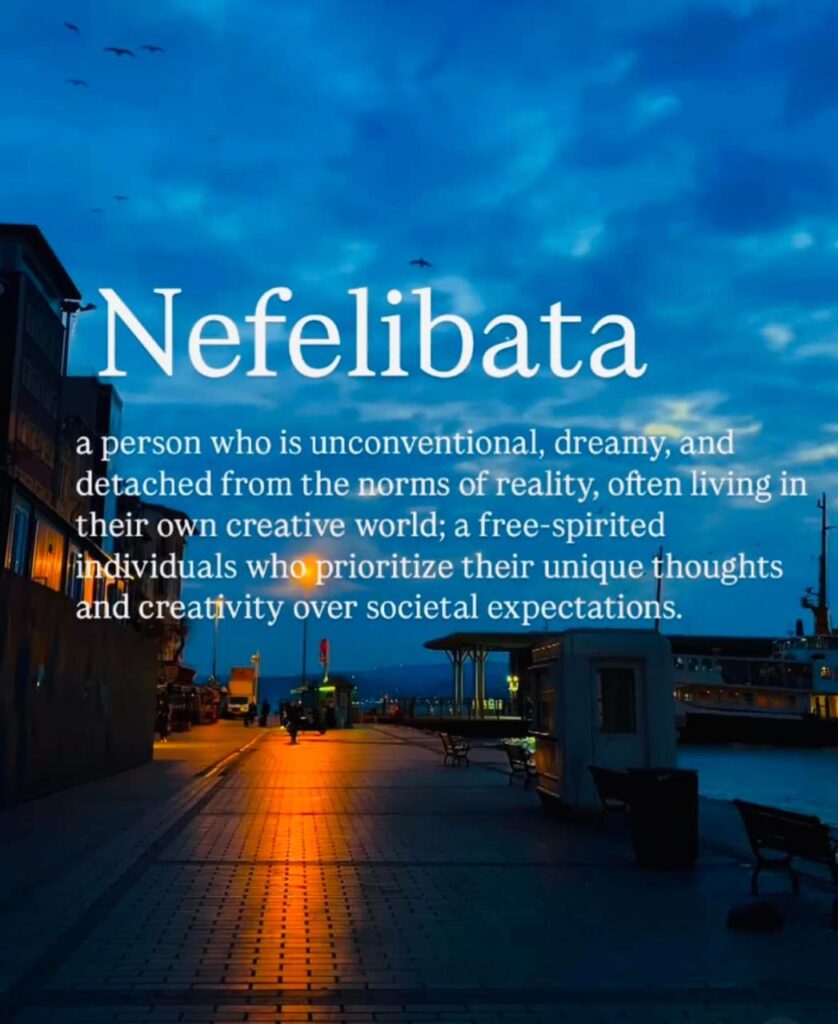
Nefelibata

A friend sent me a really beautiful picture with a word that I am not even sure I can pronounce. The word – Nefelibata – describes a dreamy individual who dances to their own tune. I jokingly asked my friend if that was me. She surprised me when she said yes. I giggled, actually. Mostly because on my best day I would honestly wish I was this person.

I have written before that I think the writer version of me is my best self. I feel that I was built to be a writer but I just didn’t know. And so, my life has taken me down roads that leave me writer-adjacent with deep longing to truly live a writer’s life. I honestly think that if I had chosen the writing track, my life would have been totally different. In some ways, I hold a belief that there is a whole life that awaits me on the other side of embracing my Nefelibata-ness.

What remains astonishing to me is that even after all this time and after all those affirmations from the interwebs, the novelty of walking the road less traveled is more a marvel rather than a lived experience. What is this courage that I (maybe you, we?) need to really live? Maybe it’s not too late to try and be Nefelibata?

Rethinking Ema

So when I first started this blog, I wanted to have a way of connecting myself as an author to my future audience. In my mind, I was going to be writing and publishing many many books every year. My dream was that I would be sensational and lots of people would want to know me… hehehe… and so my blog became performative in some sense. When I read these posts, I find only snippets of myself and wonder who this person was that wrote these words. They sound like they could be my words but they also give me a sense of holding back. Some posts are quite raw – showing my insides and make me cringe ever so slightly. Being witness to your past pain is quite a jarring experience. Being witnessed to a version that you have evolved from makes you introspect a bit more… So I guess in all this, I have a question – what is true now? What remains true? What is the essence of Ema?

I think I still want to write. I continue to write. I have some great days of discipline and some not so great days. I am surer of the voice in which I write. I am humble in my pursuit of this craft. This is truly a gift that flows its own course — to be subject to its whims is quite the lesson I sometimes need — being too sure of oneself has some downsides. I have less doubt and this makes writing that much easier. There are still stories inside me that are bursting to be told. I will try my best to honor this call. This is my greatest dream and it to be a prolific writer will be my greatest achievement.

What does this mean for Ema? The name lives on, I guess. I will continue to write and Ema will continue to publish. What I hope to create is a world that feels authentic to me – the storyteller me – you know, which is a small part of the other parts that make me, me!

Re-awakening

It’s been close to a year since I posted anything on this beautiful website. This year has been one of the hardest ones yet. I lost my writing mojo and lost my darling Father. It’s been grueling. Some days I know who I am and some days I am lost. The words to express the grief are just beneath the surface on my pain — but it’s so very hard to reach myself. And so I have been in a holding pattern.

I had a conversation with my brother yesterday. And I encouraged him about managing the sadness we feel by setting a minimum number of activities for each day. Right after Daddy died, I started with one activity minimum. I had to shower. And even then, showering was often not taking a real shower. It was hard. And then with time, I raised my minimum to three activities per day of which taking a real shower was not negotiable. You see, in the past, when I have battled depressive feelings, taking a shower has been so hard. So I knew if there’s one thing I should deal with decisively, it is showering. I leave the day open for two major activities that may include work or just managing life as an adult.

I feel like I am ready to make an upgrade to five activities per day. Showering properly is one of them and now, exercise is another. I have to put in at least 30 minutes per day. I think I will still leave two major activities open and for the last slot, I have to get the writing in.

Writing keeps me balanced and keeps me sane. It puzzles me when I am unable to write. I can’t tell if it is a sign of the state of my inner being or if it is a consequence of my true state of mind. I suppose it doesn’t quite matter. I need to do better because it really does make me feel better.

I guess my fifth commitment is about balance in the end. Writing gives me balance. And so I will write.