
Romance and Regret

I’ve been writing two characters lately. And somewhere between their dialogue and missed moments, I realized… I know these two. Not exactly. But I’ve met them. Felt like them. Maybe even been them, once or twice.

Their story isn’t dramatic. It’s not one of those love affairs that ends in broken plates and tearful monologues. It’s quieter than that. More almost than aftermath.

They remind me of all the “almost maybes” and all the loves that had so much potential. The loves that hovered just at the edge of becoming something more. The ones that fizzled without a fight. That slipped through, not because of betrayal or rage, but because no one was brave enough to say what needed saying in time.

And writing them has made me reflect on how many love stories never even begin. They just linger. In a sentence that never got said. A door no one knocked on. A moment you talked yourself out of.

I think one of the reasons I’m drawn to these two characters — the one who looks back too often, and the one who never fully showed up — is because I know what it is to hold regret. Not the loud, cinematic kind. The quiet kind. The kind that hums underneath your skin and makes you think, If only I’d been a little braver.

But the beauty of writing — the real magic — is that I get to explore all the versions of that moment. I get to ask: What if they’d stayed? What if they’d said the thing? What if they’d chosen the mess instead of the silence?

And maybe the best part? I’m not writing from a place of despair. I’m writing from possibility. From understanding. From having lived long enough to know that timing really does matter — but so does tenderness. That some of the best stories come from the tension between what was and what could have been.

So no — this isn’t just about old heartbreaks. It’s about how regret has made me a better writer. How paying attention to the ache has sharpened my ear for truth. How letting a character long for something they just missed teaches me to tell stories that are not always happy, but always honest.

And in that way, these characters are not unfinished business. They’re a new beginning.

Not a mourning. A reimagining.
Breaking the Rules

Some of the rules I broke were never written down. They didn’t hang on classroom walls or appear in handbooks. They were implied. Inherited. Expected. Like background music or elevator music or Christmas jingles that plays softly and compel you to hum along.

Be polite.

Stay agreeable.

Don’t interrupt.

Make yourself smaller so others don’t feel threatened.

Wait your turn.

Don’t want too much.

Don’t take up too much space.

And for a long time, I followed them. Quietly. Skillfully. I became really good at playing by rules I never agreed to — rules that were passed down with love sometimes, and fear other times. I keep referencing how I got my first lessons in school. But it didn’t help that we were also a military family — more rules on top of the regular ones. And then, bonus rules because we’re Kenyan. And Kikuyu. And women. It was rule on rule on rule. All of it kind of made me feel like I was supposed to be palatable instead of present.

But something shifted. Not all at once. It wasn’t a grand rebellion or a dramatic declaration. It was more like a slow peeling away. A series of quiet “no’s.” A quiet voice in my chest that whispered, “That doesn’t sit right anymore.”

It looked like saying what I meant, even when it wasn’t easy. Writing what felt true, even if it didn’t sound “nice.” Choosing joy even when it didn’t come with credentials. Wearing red when everyone else wore beige. Laughing too loud at the wrong moment — and not apologizing for it. Resting, unapologetically, in a culture that worships burnout. Saying, “This matters to me,” and not waiting for anyone to validate that truth.

At first, it felt like failure. Like I was letting someone down — someone I couldn’t quite name. Maybe a version of myself I was taught to be. Maybe the imagined voice of a teacher, or a mentor, or a silent crowd. But now? It feels like return. A return to myself. To breath. To a voice that was never meant to echo someone else’s comfort.

I don’t break rules for shock value. I’m not trying to cause a scene. I break them to breathe. Because there’s nothing holy about performing palatability. Nothing noble about being invisible.

And sometimes the most radical thing I can do is to write my own script. Even if I have to tear up the old one, line by line, and start again. It is so clearly brave.

Learning to Ask for Help

I used to think asking for help was something you did only when you had no other choice. Like a last resort. A white flag. You know how Tom and Jerry would chase each other until they were completely worn out and then one of them would wave a little white cloth in surrender? Yeah. Like that. Somewhere in my mind, there was a ka-small belief that asking for help was a quiet admission of failure. A giving up.

And let’s be honest — the 8-4-4 system didn’t help. Asking questions had to be strategic. If you weren’t careful, asking a teacher a question could rain down public humiliation. The wrong timing or tone could get you dismissed, or worse, embarrassed in front of the whole class. It taught a lot of us that strong meant silent. Silent avoided licks. Capability meant being self-contained. Getting it done without drama was the gold standard. Resilience became synonymous with smiling while exhausted. In fact, smiling while exhausted was just par for the course.

Then came Boss Babe culture. There was no relenting in that world. No room to pause. I became the one who carried it all. The one who figured it out. I knew how to check in on people, offer support, manage the chaos — but rarely answered honestly when someone asked me, “How are you?”

And maybe that worked. For a while. Until it didn’t. Until I quietly burned out and began a long, complicated love affair with anxiety. My first panic attack started this cycle of hypervigilance and self-doubt. I found myself watching for invisible enemies, always preparing, never resting. I had a plan A and B and C for everything. I resented the people who didn’t notice when they were overloading me. Who couldn’t just tell that I was tired. Who expected me to keep going because I looked like I had it together. I felt like I was battling alone. And the loneliness of that nearly took me out.

Eventually, I crashed. And with that crash came a hard truth: no one was coming to save me. Not because they didn’t care — but because I never let them know I needed saving.

Learning to ask for help has been one of the hardest things I’ve ever done. But it’s also one of the most healing commitments I’ve ever made. I don’t owe anyone my superman cape. I will not suffer alone! 😬😬😬

In the beginning, choosing vulnerability over control meant I overshared everything. I didn’t know how to ease into the ask — I just cracked wide open. But I like to think I have a bit more finesse now. These days, I know who is a safe space and I have learned how to make the ask with softness. I know the people I can let in to witness the mess without needing to clean it up. My inner circle is solid. I trust them. And letting them hold me doesn’t make me less worthy — it just makes me more human.

The miracle of asking for help is that it creates permission. It opens the door for other people to ask, too. And nothing brings me more joy than showing up with the right kind of care for the people I love. My refusal to perform strength has given others the courage to stop performing, too. The depth my relationships have found through this reciprocity. It’s beautiful. We’ve learned to hold each other, in turns. And now, “I can’t do this alone” isn’t an admission to be ashamed of — it’s a sacred little prayer.

And the truth is, I’ve been honored by the vulnerability people have shared with me. I’ve been blessed by those who’ve shown up — with meals, with voice notes, with memes, with practical suggestions and emotional oxygen. I’ve learned how to receive those things. And I’ve offered them back. In that giving and receiving, we’ve created emotionally safe spaces that feel real and sacred.

So here’s what I remind myself now:

Asking for help is love in practice. It’s not weakness. It’s wisdom. It’s a quiet, brave reclaiming of interdependence.

Still the best lesson I’ve learned.

A Love I Didn’t Keep

Some loves don’t end with drama. No betrayal. No big fight. No final goodbye yelled into a rainy night. Just slow unspooling. You find yourself thinking of them less and less. The texts become fewer. Then the pauses between replies stretch longer — before being ignored even becomes a thing. And then… there’s just no feeling. The phone calls are shorter, the silences longer. There’s awkwardness. And that strange moment when you realize the laughter isn’t quite the same, and neither of you knows how to ask why.

I used to think love had to last to be real — that if the feelings faded, then maybe it wasn’t love to begin with. But life, ha! I think now, more and more, that some of the deepest loves don’t stay. They arrive to teach you something. To stretch your heart. To open a door. And then they leave.

This is about one of those loves.

We didn’t end in anger. In fact, I feel guilt sometimes — because I ended up feeling nothing. Well, not nothing exactly… maybe a kind of passive-aggressive bitterness. A resentment that came not from betrayal but from boredom. From realizing that we were growing in different directions — slowly enough for us both to notice. It became clear that he wasn’t as motivated to stop the disintegration of us, and I was a little too tired to keep denying that the shape of us had changed. And the truth? I didn’t quite feel the loss.

Still, I remember the mornings that felt sacred. The inside jokes that made no sense to anyone else. The ways we tried. The moments we got it right. The warmth and joy and spark of it. The fire. The chemistry. The romance. The tenderness. The urgency. I remember all of it, and I (mostly) don’t regret it.

I think this might have been the first time I could look back at a relationship and feel that I was actually ready for a love to end. That loving someone and not wanting to keep them wasn’t a betrayal of my romantic ideals. And that I didn’t need to vilify him to make sense of the ending. I could simply say: he loved me — maybe not in the way I needed forever, but in the way he could, then. And that was how it was meant to be.

I still find myself wondering whether it’s okay to file this under loved and gladly shelved. I mean, I don’t think I get to decide the categories of love. Maybe they were set by the gods or the ancestors long ago — that not every love is meant to be permanent, but that doesn’t mean it wasn’t valid. There’s comfort in that, I think.

Not every ending is a failure. Sometimes it’s just a quiet closing of a chapter.

So aside from the small-small sadness, the soft ache of parting, I carry a kind of gratitude. A softness around the memory of a love that was real, even if it didn’t last. A love that mattered — for as long as it did.

I wonder if this is how it is with some friendships too.

sigh

What I Meant to Say (Do)

There are things I wish I’d said when it mattered. Not big, sweeping declarations. Just simple truths that I held back — out of fear, timing, pride, or that awful belief that I’d have another chance.

What I meant to say was: “I didn’t know how to love you right then, but I wanted to.” Or maybe: “You hurt me more than I admitted — but I still think of you kindly.” Or: “I’m sorry I didn’t show up when we agreed, because I feared you were more important to me than I was to you. I didn’t want to lose.”

I just wish those moments hadn’t been so full of fear. Or competition. Or pride. I wish my heart could have recognized when it was important to be transparent — to be bold. I wonder if people become wiser with age and can identify a pivotal moment that has the potential to change the shape of a relationship. And if that kind of wisdom exists, how can I tap into it faster?

Sometimes, the loss of the moment isn’t only about what I didn’t say — but what I didn’t do, because I thought I had more time. Lately, I’ve been remembering a conversation I wanted to have with my father before he died. I wanted to know more about him — how he grew up, how he lived, how he saw the world. I wanted an oral history. But I waited too long. I thought we had more time.

Or that man I loved so deeply. I wish I had pushed us to take the leap. But the moment passed. He was also gone. And there’s no going back.

But not everything I didn’t say was profound. Sometimes, I just wish I had expanded the moment a little. Said something like “Don’t go.” Or, “I hear you.” Or even, “Tell me more about that.” But the moment passed, and the pause was too long to say more. Or the person passed — and now I carry the words like little pebbles in my pocket. Not heavy enough to stop me, but impossible to ignore. And my heart keeps saying: I wish I had said it. Can I go back and say it? The regret lives at the base of my brain, and I rest my neck on it.

I suppose the lesson is that not every truth arrives on time. But how can I accept that there’s beauty or purpose in the delay? How do I make peace with the distance that silence — or death — creates? Accepting that the moment is gone doesn’t mean I don’t still wish I had said the words, or done the thing.

These days, I pray for the courage to speak when the urge is kind and clean. I pray I can recognize the moment when choosing now over maybe could change the shape of everything. I hope I’ve learned how to say the thing when it’s warm — not when it’s stale. To risk the awkward moment over the lingering ache of “too late.”

I wonder if it’s a skill I can master… this bravery to act in time.

Unsent Letters

I’m a romantic. So yeah… I’ve written more letters than I’ve sent.

Long, spiraling ones with no punctuation. Short ones with just one sentence I couldn’t say out loud. On napkins. On the backs of receipts. In my Notes app at 2:43 AM. In my journal — which, honestly, I dread thinking about anyone reading in the future. What will my relatives make of my late-night musings? Hehehe…

These unsent letters — some start with “I miss you,” and others begin with choice expletives. A few open with “This hurt.” Some never make it past “Dear…” before my mind takes over and rewrites the page before I can finish the thought.

I usually write them when my chest feels tight with unspoken things. When I’m not sure a conversation would fix anything, but I still need to clear the static building in my heart and head. Sometimes I write them because I fear that saying something out loud would make forgiveness feel too fragile — or worse, that naming a thing would make it impossible to ignore, and then we’d have to deal with the truth. And then… the impasse.

Most of these letters stay hidden. Tucked into drawers. Folded into ziplocks like sterilized prayers. Deleted from drafts. Forgotten altogether. A few times, I’ve burned them in the kitchen sink — not out of anger, but as a kind of quiet ritual. A release.

The truth is: some letters aren’t meant to be sent. They’re meant to be written — to make space. To say what needs to be said, not to someone else, but to yourself. That’s the real magic of being a writer. Words spoken in silence have a strange kind of power. They remind me that I haven’t abandoned myself. That I can give my feelings shape without giving them away. That I can honor my voice without needing a response. That I can choose peace over performance.

And sometimes — not often, but sometimes — the letter is a rehearsal. A first draft of the thing I’ll one day have the courage to say out loud. A soft landing before the truth is spoken with full voice.

Maybe that’s what the hidden words are for. Not drama, not even clarity — just honesty. A mirror. A rescue. A reminder of what I needed to hear all along.

So yes, I’ll keep writing them. Not for closure. Not to provoke. But because even when no one else hears it, the act of writing it down means I did. And sometimes, that’s enough.

Sistered

I am often impatient with people who talk about women not supporting one another. Mostly because that hasn’t been my story. My experience has been one of unwavering support, deep love, and women showing up — over and over again.

I have been encouraged and held. Sometimes with a timely word. Sometimes with a look. Sometimes just by someone sitting beside me long enough for my breath to slow down.

There are women who have saved me without even realizing it.

My girls are my lifeline. Starting with my wombmates — these women know how to speak life into me. The love they have for me is so deep, so true, that I feel it in my bones. I must be the luckiest girl alive, because I also have sisters by choice. Some walked in and stayed. Some were only here for a short while. But I’ve come to learn that time is not a reliable judge of sisterhood.

When I say that sisterhood isn’t just about time or biology, I mean it. Because I’ve gathered great sisters along the way. And somehow, they all speak the same language. They are fluent in love and steadfastness.

They text, “Did you eat?” or “Have you slept?” and it feels like a prayer. They show up where I am, because over the phone I said “I’m fine” — and didn’t sound it. These sisters are the ones you tell to stay away, but who still find a way to be near, without making you regret it. They’re the cheeky ones who don’t need backstory (because they just get it) and insist that you give them a blow-by-blow account of things anyway — just so you can waste time together.

There’s something holy about being known by people who aren’t trying to fix you. Who let you unravel when you need to. Who allow you to sit with whatever elephant that insists on being inside a room when Tsavo is just a few hours away. Who help you tie yourself back together when you’re ready.

This isn’t just sisterhood. This is love.

And I’m so grateful for it.

Sisterhood isn’t always loud or visible. Shucks! Love isn’t always obvious. Sometimes, it’s a quiet protection of your name in rooms you haven’t entered. A shared look across the room when the men are talking nonsense. Sometimes, it’s telling the hard truth — when it’s VERY hard — because you want each other to grow.

I’ve been held by women who remind me who I am when I forget. Who laugh like medicine. Who show up with balm and jokes and “Let’s play that French song you love on repeat while we drink Jaba juice” energy.

As a love writer, I have not talked enough about how radical it is to be loved platonically, fiercely, and without transaction. How healing it is to be rooted in a community where no one’s competing, no one’s performing, and no one needs to shrink you to feel seen.

So, I am celebrating the women who mothered me, sistered me, midwifed my joy. Who have held space when I couldn’t hold myself. Who remind me — again and again — that I don’t have to do any of this alone.

I carry so much gratitude.

My sisters make the becoming bearable… and the journey joyful.

Love in the Margins

Some of the most formative love stories of my life didn’t end in relationships. They didn’t even begin in the way stories are supposed to. No grand gestures. No well-lit first dates. Just quiet connections that existed… on the edges.

The guy who always studied with me for our classes and did joint assignments, even though we never once called it a date. The friend who made me playlists but never said the words I needed. In fact, this guy made me laugh because he could never remember when we met and yet for me, it was one of the most significant events – I felt so much for him when we were talking… joke was, for him, it was just another great conversation (!).

So many tender moments and so many left on the way. There was one guy who very quickly, after an equally brief liaison, stopped talking to me. By then, I hadn’t wisened up to college guys and their ways. He just moved on and never looked back—but knowing him sure taught me how to spot guys like him from a mile away. 

There was one with whom we had an instant connection on a flight from North Carolina to New York. We sat there looking at each other. Our shoulders moving ever so much closer. He had these beautiful eyes and it felt like it could be something. He invited me to walk Central Park with him. But before I could answer, we remembered he was engaged.

There is another stereotype I have encountered one too many a time: the almost-lover who said, “Let me get you home,” after a night out but could never quite make a move when we got to my house.

Love in the margins is tricky. It doesn’t ask for much. It thrives on eye contact that lingers half a second too long. On inside jokes. On the careful way someone says your name. It rarely announces – or pronounces – itself. But it leaves shadowy feelings. Most of the time, these comment balloons type of love, just has enough room for longing and not much else.

It took me a while to understand this kind of love. I think it took me far too long to see that some loves are not meant to unfold. They are, instead, meant to reveal. To show you what matters to you. What doesn’t. Where your boundaries are. Where your softness begins. And sometimes just to remind you that you are alive. Breathing.

These “love in the margins” people are never for a chapter in my story. They are present in memories and only ever remembered in nostalgia, or in the demands of every love scene that comes long after they are gone.

I don’t write about them often. Mostly because I don’t want to overinflate what wasn’t. But also because I know that love can be true without being permanent. That not all loves have a destination… sometimes they’re like matching in place. Love in the margins. I think this is possibly where the most human parts of love reside – not so much in declarations, but so clear in the “it could have been.” 

Where I’m From

Lately, I’ve been thinking about where I’m from.

Not in the way people mean when they ask at a networking event, or in the way passport stamps try to explain you. I mean the places that shaped the inside of me. The places that made me laugh a little differently, sit a little quieter, learn the timing of pauses between stories.

I’m from the smell of ironed uniforms on Monday mornings and shoes polished sparkling and shiny black with Kiwi shoe shine.

From porridge that tastes slightly burnt but still feels like home. And bread spread with blueband and then panfried – like French toast but without the eggs.

From relatives who were my first friends and who are so many that every get together is spent answering the same question like 15 times… and it feels like home to echo a response and be received each time with job. And relatives who can tolerate you telling the same stories every year—always louder, always funnier—with details that change depending on who is listening. 

From cousins who know what it is to play in an Ikumbi and come out covered in the white residue of shackled maize that has been stored to cook Githeri later in the year. 

I’m from long silences during car rides.

From knowing how to read moods by how people stirred their tea. Or gave you a side eye. Or held one orange colored Bata slipper. Heck even a mwiko.

I’m from shared worn out shoes, and dresses, and shirts, and hair clips… and the quiet dignity of reuse. From generosity without ceremony. From people who shared and showed up. From afternoons where the electricity went out, and someone started singing in the dark.

There are parts of me that were shaped not by big events, but by small repetitions. The way a plastic chair creaks under your weight during a long story. The rhythm of a name answered three different ways depending on who’s calling it. The softness of my mother’s voice when she prays for us—not performatively, but from somewhere deep inside her chest. And loudly on Saturday morning which was so annoying when you’re trying to sleep!

I’m also from people who often said things that made me cry at night because their honesty was sometimes cruel. From whispered tales shared in phone calls and catchups and today, from WhatsApp messages. From family gatherings that always wanted to ask if I should join the gym and I fought the urge to punch people in the face. From questions about love and marriage – and having no answer to give over and over again. From women who never said I love you but insisted on singing a chorus after a family gathering and saying a prayer of protection and journey mercies. 

I’m still from those things. Even when I live elsewhere. Even when I sound different. Even when I write in a voice that someone might call “neutral.” Even when I silently withdraw from gatherings that seem a bit more hostile than I would like but still strike a chord of longing inside me.

I carry these people, moments, conversations, tears, and everything else in my silences. In the way I pace a paragraph. In the way I don’t always finish a thought.

Where I’m from isn’t just a location. It’s a cadence. A palette. A way of remembering.

Love is…

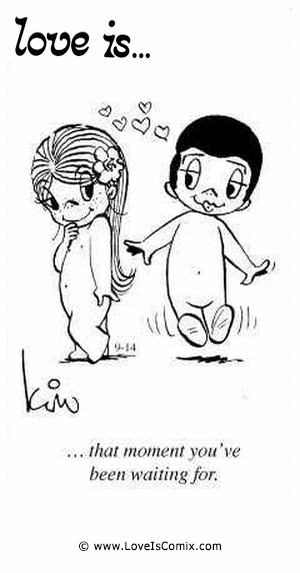
So when I was younger I religiously read one of our daily newspapers, The Daily Nation, because it had this comic strip – Love is – which it turns outs, has an awesome love story about its creator and how she drew the cartoons for her future husband… *swoon*

I used to race each day to find what love was each day and I savored every reading.

Recently, I have been wondering what love really is — especially now that life has happened to me and things are not what I thought they would turn out to be.

Turns out that love is not as simple for me as I thought it would be. Unrequited feelings, loss, and personal tragedies make it difficult to ease into love or even to trust that things work out. Isolation is a safer space than it should be for a romantic… and I am far more familiar with loneliness than I ever thought I would be.

But this is not the only story about what love is or has been. I have loved many wonderful souls and some were really wonderful people to love. I have loved others who did not love me back. I was loved by some that I did not love back. So, really, love has been a retrospectively wonderful experience.

Some days, though, like today, love seems to be one endless journey of searching, connecting, disconnecting, falling and failing, and I suppose for the most part, just waiting. Waiting for something magical to find me and surprise me and stick with me… in the most pleasurably challenging ways.