
What I Meant to Say (Do)

There are things I wish I’d said when it mattered. Not big, sweeping declarations. Just simple truths that I held back — out of fear, timing, pride, or that awful belief that I’d have another chance.

What I meant to say was: “I didn’t know how to love you right then, but I wanted to.” Or maybe: “You hurt me more than I admitted — but I still think of you kindly.” Or: “I’m sorry I didn’t show up when we agreed, because I feared you were more important to me than I was to you. I didn’t want to lose.”

I just wish those moments hadn’t been so full of fear. Or competition. Or pride. I wish my heart could have recognized when it was important to be transparent — to be bold. I wonder if people become wiser with age and can identify a pivotal moment that has the potential to change the shape of a relationship. And if that kind of wisdom exists, how can I tap into it faster?

Sometimes, the loss of the moment isn’t only about what I didn’t say — but what I didn’t do, because I thought I had more time. Lately, I’ve been remembering a conversation I wanted to have with my father before he died. I wanted to know more about him — how he grew up, how he lived, how he saw the world. I wanted an oral history. But I waited too long. I thought we had more time.

Or that man I loved so deeply. I wish I had pushed us to take the leap. But the moment passed. He was also gone. And there’s no going back.

But not everything I didn’t say was profound. Sometimes, I just wish I had expanded the moment a little. Said something like “Don’t go.” Or, “I hear you.” Or even, “Tell me more about that.” But the moment passed, and the pause was too long to say more. Or the person passed — and now I carry the words like little pebbles in my pocket. Not heavy enough to stop me, but impossible to ignore. And my heart keeps saying: I wish I had said it. Can I go back and say it? The regret lives at the base of my brain, and I rest my neck on it.

I suppose the lesson is that not every truth arrives on time. But how can I accept that there’s beauty or purpose in the delay? How do I make peace with the distance that silence — or death — creates? Accepting that the moment is gone doesn’t mean I don’t still wish I had said the words, or done the thing.

These days, I pray for the courage to speak when the urge is kind and clean. I pray I can recognize the moment when choosing now over maybe could change the shape of everything. I hope I’ve learned how to say the thing when it’s warm — not when it’s stale. To risk the awkward moment over the lingering ache of “too late.”

I wonder if it’s a skill I can master… this bravery to act in time.
Unsent Letters

I’m a romantic. So yeah… I’ve written more letters than I’ve sent.

Long, spiraling ones with no punctuation. Short ones with just one sentence I couldn’t say out loud. On napkins. On the backs of receipts. In my Notes app at 2:43 AM. In my journal — which, honestly, I dread thinking about anyone reading in the future. What will my relatives make of my late-night musings? Hehehe…

These unsent letters — some start with “I miss you,” and others begin with choice expletives. A few open with “This hurt.” Some never make it past “Dear…” before my mind takes over and rewrites the page before I can finish the thought.

I usually write them when my chest feels tight with unspoken things. When I’m not sure a conversation would fix anything, but I still need to clear the static building in my heart and head. Sometimes I write them because I fear that saying something out loud would make forgiveness feel too fragile — or worse, that naming a thing would make it impossible to ignore, and then we’d have to deal with the truth. And then… the impasse.

Most of these letters stay hidden. Tucked into drawers. Folded into ziplocks like sterilized prayers. Deleted from drafts. Forgotten altogether. A few times, I’ve burned them in the kitchen sink — not out of anger, but as a kind of quiet ritual. A release.

The truth is: some letters aren’t meant to be sent. They’re meant to be written — to make space. To say what needs to be said, not to someone else, but to yourself. That’s the real magic of being a writer. Words spoken in silence have a strange kind of power. They remind me that I haven’t abandoned myself. That I can give my feelings shape without giving them away. That I can honor my voice without needing a response. That I can choose peace over performance.

And sometimes — not often, but sometimes — the letter is a rehearsal. A first draft of the thing I’ll one day have the courage to say out loud. A soft landing before the truth is spoken with full voice.

Maybe that’s what the hidden words are for. Not drama, not even clarity — just honesty. A mirror. A rescue. A reminder of what I needed to hear all along.

So yes, I’ll keep writing them. Not for closure. Not to provoke. But because even when no one else hears it, the act of writing it down means I did. And sometimes, that’s enough.

Healing is Less Ruler and More Slinky

I used to think healing was a straight line.

I think when your heart is broken, action feels like the answer. And there was a time when I believed that if I journaled enough, prayed enough, forgave enough, read enough, I’d cross some invisible finish line and finally feel… whole. There were many nights when I’d lie awake imagining that one day I’d wake up and not flinch when certain memories tapped me on the shoulder. That I’d reach a place called healed and never have to feel the ache again — or wince at the memory that still stings.

Oh! But how life has humbled my youthful angst for perfection and destination highs. How it’s softened my obsession with tidy arcs and destination highs. I know better now. I think I have spent the last few reckoning with the great revelation of being a beautifully flawed human: healing is not a finish line. It is less ruler and more slinky.

My experience has shown me that healing circles back far more often than you’d like. It is not unusual to revisit old wounds from new angles. Like an obsessive detective in a crime procedural, you return to the scene again and again — only this time with new tools, a bit more breath in your body, and the faint hope that maybe, this time, you’ll be able to put something to rest.

I think healing is a quiet hope that we’ll survive these re-visits. At first, setbacks feel like monumental failure. I have started therapy sessions with a sigh and a frustrated, “I thought I was past this.” But these days, I’m convinced Shrek was right all along. We really are onion people, layered and tender in places we didn’t know were still sore.

To be patient with the spiral nature of healing is to celebrate the difference between surviving something… and beginning to understand it. So now, instead of panicking when I find myself back inside a familiar ache, I pause. I try — gently — to hush the self-blame and ask my inner critic, “Why is this memory asking for attention right now?” And I have to say, that alone feels like progress. Sometimes, making that small pause meaningful feels like a kind of healing.

I’ve come to understand that healing doesn’t mean the pain is gone. It means that I tend to the places that still call out when touched. I sit with the memory that hurts. I spend time reframing the story. Sometimes, I even rewrite it.

As I’ve matured, I’ve learned to humbly ask for softness around the spaces within that still echo. I’ve stopped asking for permanent freedom. Instead, I ask to return — next time — without shame.

I ask for light to meet me again at the next appointed spiral point.

Writing While Afraid

No one tells you how loud fear can be in a quiet room.

You sit down to write and suddenly everything gets noisy.

What if it’s not good enough? What if no one relates?

What if this is the piece that exposes too much?

There are some stories I’ve carried for years. Not because they’re particularly extraordinary, but because they’re… fragile. I know once I say them out loud, they’ll change shape. They’ll become shared. And that scares me.

I’ve written whole essays only to delete them at the last paragraph.

Closed journals mid-sentence. REFUSED TO READ journals because I was afraid of what I would find there. Typed confessions and then backspaced myself out of them.

It’s not that I want to hide. (ok, so maybe yes, I want to run from what I will find there… but let’s focus!). It’s that I don’t always feel ready to be fully seen or even to see myself. Sometimes the truth feels too naked. Too raw. Too soon.

But here’s the thing I keep learning:

Some of the best things I’ve written were written scared. 

Not because I had conquered the fear.

But because I decided that fear wasn’t the final editor. Oh! The joy of meeting myself in that vulnerable space was so so special. There’s a special kind of power in writing through the trembling and putting your finger to the page despite the doubt. When I am able to brave the truth, it resonates so deeply… it is not perfect but it so faithfully speaks about the condition of the heart and soul, of the experience of the moment… and there’s no greater gift!

I don’t always publish those pieces. In fact, many of them stay tucked in my folders, or sit quietly in my handwritten journals. It’s kind of like a waiting room of all my little projects waiting for their number to be called. But even as they wait, there’s something comforting about a storehouse of written stories. And I know that when the time is right and when the stars align and the main something shifts, I will be able to share. 

In any case, the act of writing is a kind of exhale and so, I continue to be convinced that even if I am afraid, I should write. Slowly I am accepting the journey of then taking the next step and sharing it anyway. Especially sharing those that feel the scariest to look at.Ultimately, for a writer and a storyteller, fear doesn’t mean stop. Sometimes, it just means pay attention and speak in the text. 

How I Lost My Rhythm

There was a time when I wrote like breathing.

Not every day, but often enough to feel like I had a rhythm. A cadence. A pulse.

And then one day — I didn’t.

No dramatic event. It felt like a series of tragedies and a car in a slow-motion skidding off a winding road and into the abyss of a canyon… or maybe since I am in Kenya… picture driving the Mai Mahiu Road just after the View Point and winding off the banking and into the Rift.  

The way my ability to write left me… No grand announcement. Just a quiet grinding to a stop. Like faulty gears whose teeth are stuck.

Suddenly, writing felt like trying to catch a moving train while half-asleep. My ideas came foggy and late. The characters in my head stopped speaking. Sentences no longer danced — they stumbled. Or sometimes sat mute between full stops and elipses.

For a while, I told myself that I was just tired. I’d get back into it “soon.” You know, after I finished that thing, solved that crisis, bought that lamp, reorganized that drawer. Maybe if I got an Apple Pencil so that I could scribble like in a notepad but the words could be transcribed to text. Or maybe I could dictate my thoughts and then transcribe the records. OR I could actually commit to NaNoWriMo.

But “soon” left me by myself in the deep Rift of nothingness.

And then the guilt started stacking.

I’d open my laptop, scroll through old drafts, wince. Start a sentence. Delete it. Close the tab. Repeat. 

I even got an expensive Writing Coach… who I ghosted! At least we got to Chapter 3. I still haven’t opened the emails with the notes on Chapter 1 and 2.

People kept asking about my next book. Friends I hadn’t seen in a while asked, “Are you still writing?”

The answer was always a tentative “Yes!” 

To which my conscience would scream “LIAR!!!”

Other times, I would narrate my plot story line.

Other still would be met with a near honest, “Sort of.”

What I meant was, “I don’t know how to explain that I’ve lost the rhythm of myself.”

That the comfort of writing was no longer soothing. And the sadness inside me was all wastelands. No words.

So. Here’s what I’ve come to understand:

I didn’t stop writing because I became lazy. I stopped because I was surviving. Because I was tired in the kind of way sleep couldn’t fix. And the feelings I had were like mud or black, tarry, gooey melted asphalt. 

I have come to understand that somewhere in all the striving, I stopped listening to myself.

And rhythm — real rhythm — requires listening.

It requires stillness. It requires a lot of honesty. 

Presence. And reckoning. The ability to say “Whoosh! I am in a difficult space.” And then to quiet and just allow the soul the attention. I mean the kind of soft attention that’s hard to access when you’re just trying to make it to next week without collapsing. Or wake up without the heaviness of being alive.

Fast forward to this year, something’s shifted. I feel lighter. I feel buoyed (you know like that bobbing orange ball that they keep near boats and things). I’ve started humming again while brushing my teeth. I’ve caught myself narrating random scenes in my head. Started seeing the imaginary spaces where stories form come alive with color again. I’ve started writing things in the margins of my journal and even randomly between meetings on open Word documents… hehehe…

The rhythm is not back in full. But I can hear it again. Faint. Familiar. Like music playing softly in another room.

I feel compelled to follow the sound. Slowly. Steadily. No rush.

Because the thing about rhythm is: it always leaves room for return.

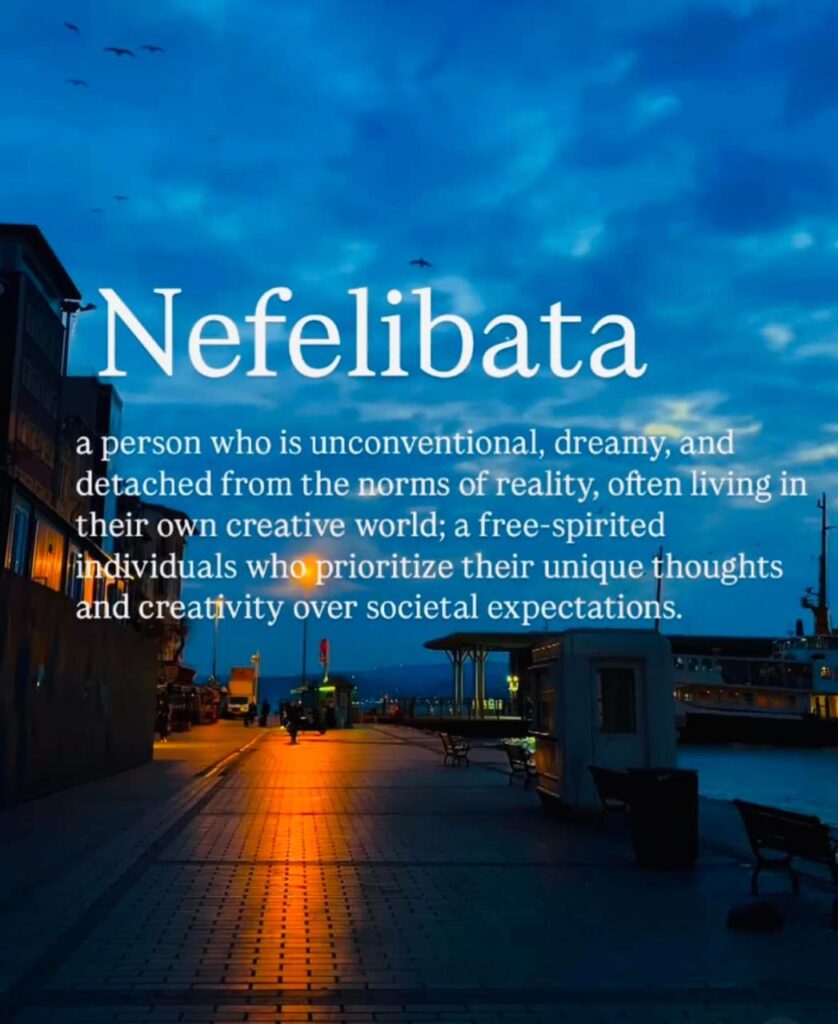
Nefelibata

A friend sent me a really beautiful picture with a word that I am not even sure I can pronounce. The word – Nefelibata – describes a dreamy individual who dances to their own tune. I jokingly asked my friend if that was me. She surprised me when she said yes. I giggled, actually. Mostly because on my best day I would honestly wish I was this person.

I have written before that I think the writer version of me is my best self. I feel that I was built to be a writer but I just didn’t know. And so, my life has taken me down roads that leave me writer-adjacent with deep longing to truly live a writer’s life. I honestly think that if I had chosen the writing track, my life would have been totally different. In some ways, I hold a belief that there is a whole life that awaits me on the other side of embracing my Nefelibata-ness.

What remains astonishing to me is that even after all this time and after all those affirmations from the interwebs, the novelty of walking the road less traveled is more a marvel rather than a lived experience. What is this courage that I (maybe you, we?) need to really live? Maybe it’s not too late to try and be Nefelibata?

“Yes!” in perpetuity

Ok so I did this crazy thing and went to exhibit at the 2019 Nairobi Book Fair. I got the Judges’ Choice Award which was amazing… I felt embraced by the Universe. And so affirmed. I was so extra with the whole experience as I organized for a photographer to take beautiful pictures of the Booth… and me at the booth… and my many friends who came out to support me at the Booth.

I experienced magic in the many individuals I got to hug and be around. For me, seeing and being open to people I would never have otherwise met without putting on anything, was eve’thing.

I loved sharing and listening and being surrounded by other writers. There were so many different journeys that collided there and to witness it all was amazing.

You know, last year was the year of “Yes!” for me… but it seems to me that I have a year’s lag on this yes thing. I have been saying a lot more yes this year than ever before… Maybe it’s a yes in perpetuity thing… either way, I am loving the magic.

When I read my confessionals

So a crazy thing happens… I first have to brace myself. I think it’s because I am never quite sure how reading what I wrote is going to make me feel.

Sometimes I shock myself and sometimes I feel shame. Shock – because of how much I reveal. Shame – because of how much I reveal. Most of it is mixed admiration and the early makings of an emotional hangover… probably because I am often surprised at what I am willing to admit when I am writing. How vulnerable I truly am.

I also read in between the intention of wanting to be clever… and perhaps, some trace subtext of relief… and just a tinge of satisfaction at being able to write it all.

I often say, many times like an old grandpa with repetitive jokes, that I think the best version of myself is the writer. I allow myself so many freedoms when I am in this space. I give myself lots of room to just be… and this is a gift I seldom give myself when I consider all the other versions of me that are running around.

I like the idea of re-reading what I have written because I have the courage not to be dishonest with myself. In this confessional, I think I am assured of at least one place where I can reflect my truths back. This is not all a bad thing.

Can I be me?

So a while back I watched one of the many docu-stories on Whitney Houston on Netflix. It was all very riveting… I mean, she was the queen of voice, right? Super Bowl XXV and Star Spangled Banner…

Anyway, one of her docu-stories has stayed with me. I can’t remember the title – it might even be the same title as my post – but in one of the most poignant scenes, they tell her that she’s about to go on an interview and she innocently (so hopefully) asks, “Can I be me?”

Now, I don’t recall the exact answer she gets but the change in her face makes it clear that it wasn’t what she wanted to hear. And you can almost see her slowly shift into a manufactured person. The vibrancy in her eyes fades. But she does well in the interview. Her responses are well-timed and seasoned with the right amounts of bubbly. And she… she is so very severely diminished.

I revisit that image and scene in my mind often. When I encounter people who have high walls and eyes full of secrets. When I try to shade myself and make it look like feminine mystique (I often fail miserably — but the efforts are hilarious even to me). When I hear pain in stories that are so bravely told. When I hear deprecating humor and sarcasm come through in conversations. When I see longing in children’s eyes for affirmation from their siblings. When I hear my mother missing me but trying so hard not to say so. When I see my friend act out only to pull back in shame and guilt. When I interact with people at work and struggle not to reach out a hand and say, “Just be you… I promise to be me, in return.”

I don’t know why the process of human domestication requires denial of vital parts of ourselves.

Maybe the stress and exhaustion of work everyday is not in the tasks or the cleverness demanded by the roles we play. Maybe it is from the shimmying in and out of these necessary performances. Maybe our greatest fetes as humans is not in exhibiting consciousness but in the continuous acting and performance we do and pass off as living life.

Maybe it’s not as bad as I making it sound — gosh I am obsessed with the story behind the story, aren’t I?

I wonder who will serve up “Can I be me?” face today.